California State University, East Bay-BSN Ed Project
The BSN-Ed Project is part of the RHSC. The Reproductive Health Service Corps (RHSC) is funded through the California Department of Health Care Access and Information (HCAI). The Corps brings together six partner organizations committed to advancing reproductive health education across California:
- TEACH
- UCSF School of Nursing
- CSU East Bay, BSN Ed. Project
- Nurses for Sexual and Reproductive Health (NSRH)
- ACTIONS
- Black Midwifery Fellowship
Together, these organizations work to develop and update curricula and training opportunities that support comprehensive reproductive health education for health care professionals throughout the state.
As part of this initiative, the CSU East Bay Broadening Sexual and Reproductive Health (SRH) in Nursing Education (BSN Ed) Project seeks to establish core competencies for registered nurses in sexual and reproductive health care, including abortion care. The project also aims to standardize and expand the integration of SRH content within nursing education programs.
This work emphasizes:
- Online abortion care course with clinical simulation
- Education that reflects the full scope of nursing practice
- Nursing faculty training, collaboration, and community building in California
Faculty Learning Community Cohorts
Our first Nursing Faculty Learning Community (FLC) Cohort (2025–2026) has successfully completed its inaugural program cycle. Participants began in Fall 2025 and concluded in Spring 2026.
We are now preparing for our next cohort, which will run from Fall 2026 through Spring 2027.
If you are interested in joining the Fall 2026 cohort, we encourage you to complete the enrollment form during the open enrollment period. Enrollment opens in September 1st, 2026 and closes on Monday, November 30, 2026.
Please be sure to submit your enrollment form before the deadline to be considered for participation.
- Attending an in-person training at CSU East Bay (airfare and lodging will be provided)
- Participating in three follow-up Zoom webinars after the training
- Completing the course on Canvas
► Domain 1: Person-Centered Care Related to SRH
2. Engage in ongoing self-reflective SRH values clarification to differentiate personal beliefs, including implicit and explicit biases, from professional values and responsibility.
3. Demonstrate the use of patient-centered care (PCC) and trauma-informed care (TIC) by using therapeutic communication to deliver evidenced-based holistic SRH care tailored to the patient's needs and social identities.
3b. Communicate the risks, benefits and alternatives to SRH care with the patient and their support system and employ shared decision-making techniques that facilitate informed consent and informed refusal.
3d. Differentiate between sex assignment at birth, gender identity, gender expression and sexual orientation.
► Domain 2: Local, State, and Federal Resources for SRH
5. Integrate patient preferences to offer referrals/linkage to medical health care and community resources to address the patient's social, physical, mental, spiritual and emotional needs.
8. Demonstrate knowledge of social and political determinants of health as it relates to SRH access.
9. Describe the barriers and protections that state and federal health law and policy has on patient access to care/services/insurance.
► Domain 3: Sociopolitical History Related to SRH
10. Identify the social, political, historic factors that drive patient-provider interactions, including medical mistrust, reproductive healthcare coercion, discrimination and exclusion of social groups that impact patient presentation, disclosure, and health outcomes.
10a. Integrate knowledge of social, political, structural, and historical determinants of health to tailor SRH care.
► Domain 4: SRH Pharmacology
11. Describe the medications and protocols used for contraceptive methods including eligibility, routes of administration, mechanism of action, side effects, adverse effects, and contraindications.
11a. Demonstrates the ability to counsel patients on contraceptive options by including the recommended use and typical use, emphasizing informed choice, assessing individual risks and benefits, and ensuring decision-making is free from coercion.
12. Describe the medications and protocols used for medication and procedural abortions including eligibility, routes of administration, mechanism of action, side effects, adverse effects, and contraindications.
► Domain 5: SRH Direct Patient Care
16. Describe interpersonal violence (IPV), including its definition, types, dynamics, and risk factors, incidence and prevalence including the physical, mental and emotional health risks associated with IPV and incorporate this into patient teaching, health assessment and screening.
17. Demonstrate effective trauma-informed care during IPV screening and assessment using a person-centered approach.
18a. Apply knowledge of universal STI screening recommendations to complete an individualized risk assessment and plan of care.
19. Identify and differentiate bacterial, viral, and parasitic STIs and discuss disease process and progression including risk associated with undiagnosed/untreated infection, routes of transmission, presenting symptoms and asymptomatic presentation, available diagnostic assessments and treatment options and follow-up/monitoring needs.
19a. Demonstrate ability to conduct focused assessments to identify clinical manifestations of STIs.
19b. Provide accurate education on chronic STI infection process and management.
21c. Differentiate between normal and abnormal vaginal discharge, including clinical features of STIs, bacterial vaginosis (BV) and yeast infections.
22. Describe the anatomic, psychological and physiological changes to a pregnant person during prenatal, intranatal and post-partum periods.
23. Identify and select the appropriate pregnancy verification method and timing to confirm pregnancy location, completion of miscarriage or abortion.
24a. Describe and differentiate between types of spontaneous pregnancy loss (early, late, stillbirth).
24b. Demonstrate use of various methods of gestational dating including LMP, ultrasound, and fundal height measurements.
24c. Describe the stages of embryonic and fetal development and incorporate correct terminology into patient education surrounding prenatal care and pregnancy loss.
25b. Identify possible pregnancy loss using comprehensive assessment and determine the need for expectant, urgent, or emergent intervention.
26. Apply knowledge of breastfeeding/chestfeeding physiology to provide lactation induction and cessation support for people producing human milk.
29. Describe hormonal and physical changes throughout the lifespan including but not limited to menstrual cycle, sperm production, puberty, and menopause.
30. Provide evidence-based, person-centered options counseling based on patients desire for continuing pregnancy or abortion, including parenting, adoption, and types of abortion.
31. Describe various methods of emptying uterine contents including but not limited to medications and procedural evacuation, electric and manual vacuum aspiration, dilation and evacuation, and dilation and curettage.
31a. Apply comprehensive understanding of abortion eligibility criteria, integrating clinical guidelines, legal requirements, and professional scope of practice, to abortion options counseling.
33. Provide comprehensive pre, intra and post-SRH procedural care including but not limited to lab tests, screenings, medication administration, and patient assessments based on procedure, such as procedural abortion, egg retrieval, and male and female sterilization.
33a. Provide post-abortion recovery education including but not limited to monitoring for complications, return of fertility complication assessment and intervention, patient education, abortion discharge education, recuperative care, reproductive health prevention counseling, STI, contraception, and sexual wellness.
35. Differentiate between consensual sex, coercive sex, sexual assault, human trafficking and the commercial sexual exploitation of children (CSEC).
38. Advocate for improved public health access to evidence-based SRH services.
39. Utilize evidence-based guidelines and research to recognize and dispel myths related to SRH.
Abortion Care Training
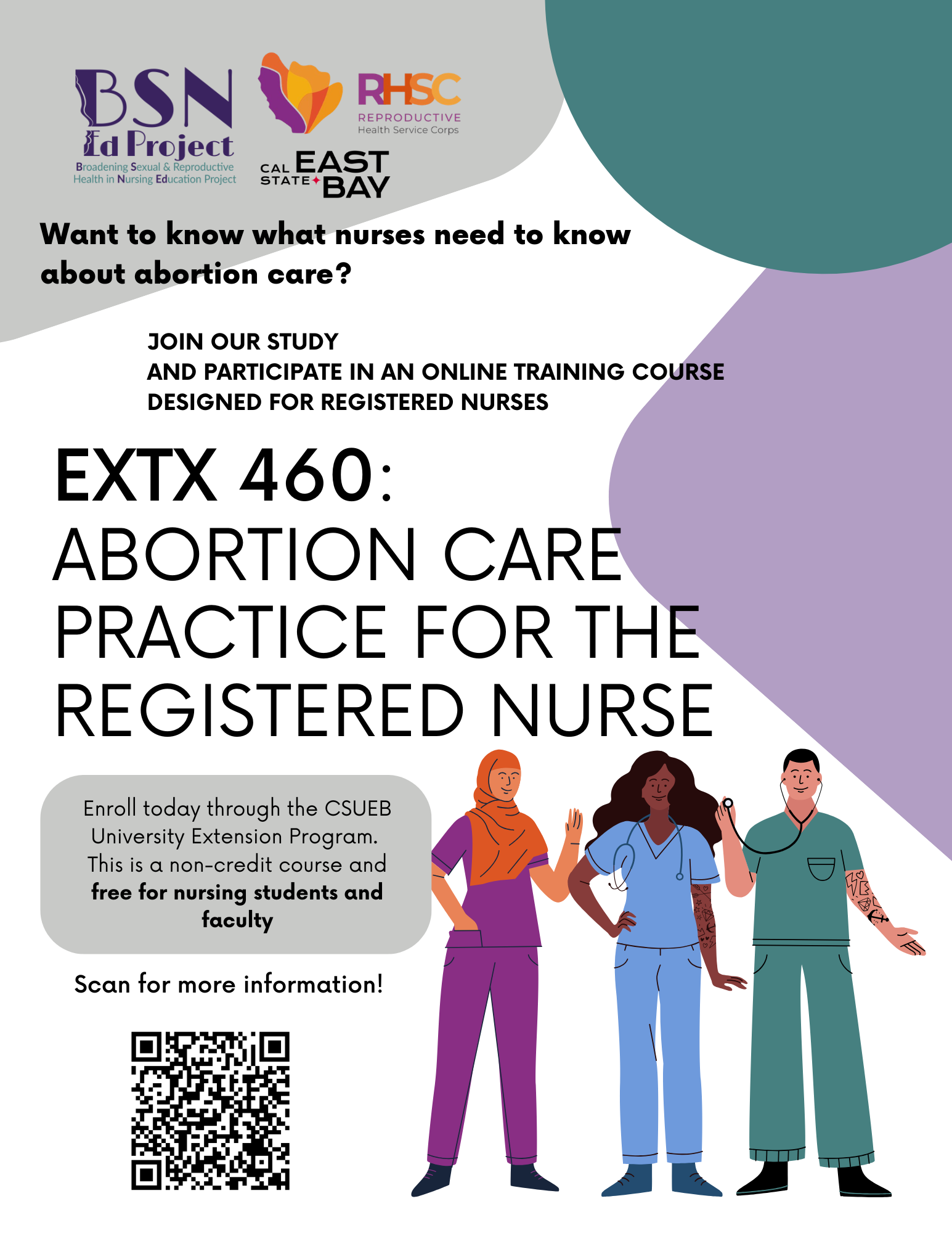
Class Title: EXTX 460: Abortion Care Practice for the Registered Nurse
Interested in taking this course? Click here to complete the course enrollment form.
Once the form has been completed, the BSN Ed Project team will contact you to arrange your access to the CSU East Bay course.
This course is a free, online, and asynchronous with clinical simulation.
For more information and resources from our partner organizations, please visit:
Nurses of Sexual and Reproductive Health:
Reproductive Health Service Corps:
https://reprohealthservicecorps.org/