Primed for Amazon: A Cal State East Bay student’s path to the world’s most complex logistics company
BY Ben Soriano
January 30, 2026
Cal State East Bay recently rebuilt its website to help prospective students find answers faster, navigate more intuitively, and see themselves reflected in the University from the first click.
It was complex work, marked by tight timelines, constant testing, and decisions that would shape how future students first encountered the campus. It also relied heavily on student employees—people expected not just to assist, but to contribute.
Ilse Mendoza was still an undergraduate in Industrial Engineering when she joined the website redevelopment team. She didn’t arrive with an IT background. What she brought instead was a way of working shaped long before she ever logged into a project meeting.
“I was always very curious and liked problem solving,” Ilse said.
That curiosity became her entry point. Working alongside website expert and former student employee Krishneel Kishor, who had once held her role himself, Ilse stepped into an environment where expectations were real and responsibility was shared.
“She’s a great example of what happens when students are given meaningful responsibility,” Kishor said. “The work is real, the standards are real—and students rise to that.”
Ilse didn’t fake confidence she didn’t yet have. She learned.
“She consistently tried to work through challenges on her own first,” Kishor said. “And when she did ask questions, they were thoughtful. That balance—knowing when to push forward independently and when to seek guidance—is a critical professional skill.”
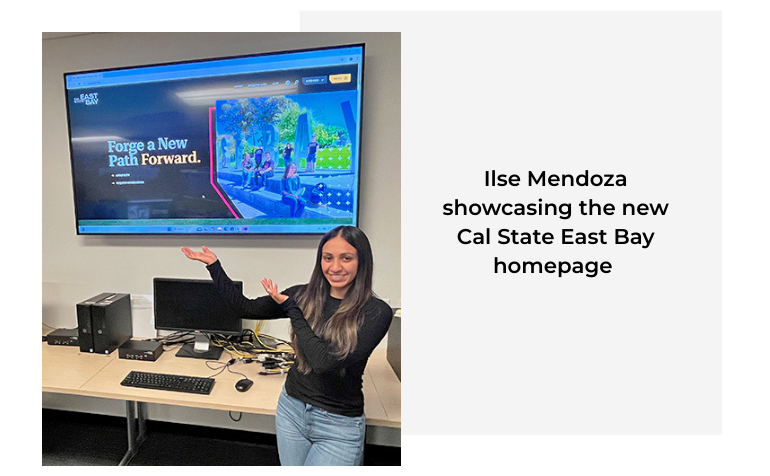
Her role in ITS Web Services involved building and maintaining documentation, creating training materials, and helping project-manage web initiatives across campus. It required structured thinking, clear communication, and an ability to manage competing priorities—skills that would later matter far beyond the website.
“She picked up development and content management tools quickly,” Kishor said. “Even though she wasn’t a computer science major, she became comfortable working within our systems and eventually helped train others.”
For Ilse, that work unfolded alongside a demanding schedule.
While attending classes full time, she was also working in a warehouse for 40 hours a week, often on graveyard shifts.
“I was working from, like, 5:30 p.m. to 5 a.m.,” she said. “Twelve-hour shifts.”
She would leave work as the sky began to lighten, sleep in fragments, then head to class.
“That’s something I kind of regret,” she said. “But at the time, I felt like I had to.”
Industrial Engineering gave her language for what she was already living. The discipline focuses on how people, time, space, and resources intersect with efficiency, process improvement, and the human side of systems.
“At Amazon now, I’m seeing a lot of similarities,” Ilse said later, after completing her first weeks of training. “It’s about processes, metrics, labor planning, space—figuring out how many people you need and how to use resources better. I notice a lot of crossover.”
That work ethic didn’t begin in college.
Ilse is the youngest of four siblings, raised in Hayward just minutes from campus. Her parents immigrated to the Bay Area from small towns in Jalisco and Colima, Mexico, arriving with little certainty beyond the need to work.
Her father spent decades with the same restaurant employer before eventually opening a lonchera (food truck) in Hayward. Her mother built a house-cleaning business from scratch.
“When I was around 12, we’d wake up really early on Saturdays, like 6 in the morning,” Ilse said.
They would cross the San Mateo Bridge and clean homes in Palo Alto and San Mateo, sometimes followed by office jobs later in the day.
“We wouldn’t get home until like 5 p.m.,” she said. “I remember hating it. I just wanted to spend time with friends.”
In hindsight, those Saturdays quietly shaped how she understood work, responsibility, and endurance.
“I didn’t think much of it at the time,” she said. “But that’s how I learned.”
College was never just about her.
“I wanted to do it for them,” she said of her parents. “I wanted to change their life, change the route, and help them out.”
Financial aid made Cal State East Bay possible. Student employment made it sustainable. Her coursework sharpened her systems thinking. Her job on the website project gave her something else: proof that she could perform in professional environments under real constraints.
“Ilse consistently applied what she was learning in class to her work,” Kishor said. “Process improvement, documentation, structured problem solving—she did that every day. That’s the kind of preparation employers notice.”
Just weeks after graduating in December, Ilse packed her bags again.
This time, she was headed to Seattle.
Ilse is now an Area Manager with Amazon, part of a graduate hiring cohort selected into a role that most often goes to internal promotions or experienced external hires. Starting at Amazon as a manager is significant—not just because of the responsibility, but because it places new hires who they trust directly into people leadership inside one of the most complex operational environments in the world.
“There weren’t many graduate hires in my class,” she said. “Most people already had years of experience.”
Krishneel Kishor sees that context clearly. “Area Managers at Amazon are expected to analyze workflows, manage teams, document processes, and continuously improve operations under real constraints,” he said. “Those aren’t entry-level expectations. Starting there says a lot about the level of trust placed in a candidate like Ilse.”
Her training began immediately, often starting at 2 a.m., inside Amazon’s operations academies, followed by long hours of independent coursework.
“It’s been a lot of adjusting,” she said after two weeks on the job. “But I’ve worked graveyard shifts before. It’s not new to me.”
Amazon’s fulfillment centers are data-driven logistics environments built on forecasting, labor planning, automation, and constant iteration. It is a world where process thinking and people management converge.
“I feel like everything I’ve done kind of led me here,” Ilse said. “School, work, all of it.”
Kishor sees that throughline clearly.
“Ilse exemplifies what’s possible when strong academic preparation is paired with meaningful work experience,” he said. “Her success reflects her drive, but also the value of an education that emphasizes applied learning and real responsibility.”
Cal State East Bay didn’t manufacture Ilse’s work ethic. It gave her space to apply it.
From a Hayward apartment at dawn.
Across a bridge into Silicon Valley.
From graveyard shifts to classrooms.
From a student employee role to operations leadership inside one of the world’s most complex logistics networks.
Ilse’s story reflects the kind of student Cal State East Bay is built for—curious, resilient, grounded in responsibility, and ready to learn by doing.
For students who see themselves in her path, the route forward isn’t hidden or hypothetical. It starts here, with opportunity, trust, and the chance to turn hard work into momentum.
Share this story