Campus Fee Advisory Committee
-
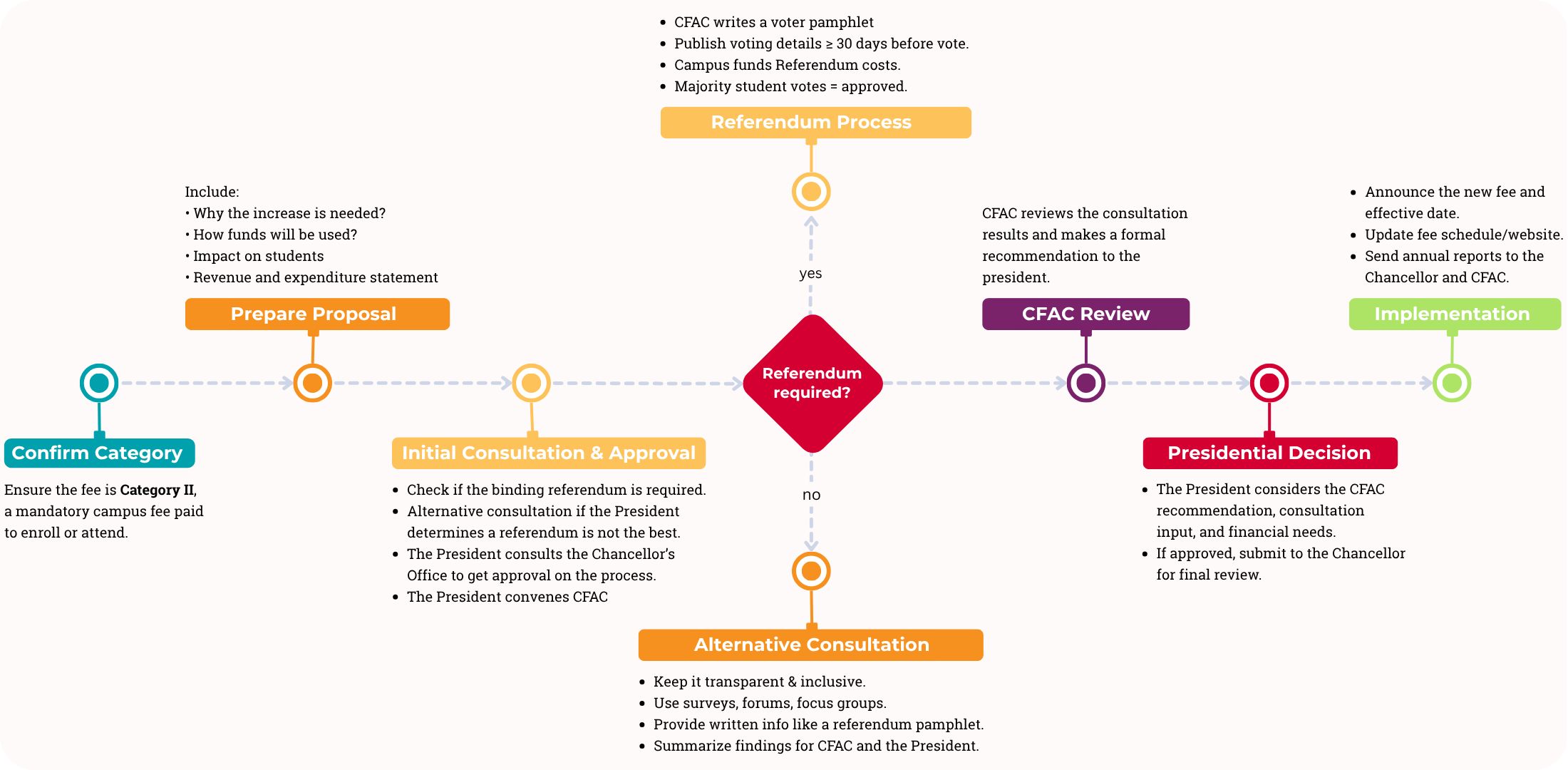
Verify that the proposed fee qualifies as Category II under campus policy.
-
Develop a formal proposal that includes:
- Purpose & Justification – Why the increase is needed
- Planned Uses of Funds – How the additional revenue will be spent
- Impact on Students – Benefits or changes students can expect
- Financial Details – One year of actual expenditures + two years of projected budgets
-
Determine if a student referendum is required by policy.
If not, the President may choose an alternative consultation process after consultation with the Chancellor’s Office and the Campus Fee Advisory Committee (CFAC).
-
Option A – Referendum
- CFAC prepares an official voter pamphlet with for and against statements.
- Publish election details at least 30 days before voting.
- The university funds all referendum costs.
- A majority of students voted in favor = approved.
Option B – Alternative Consultation
- Ensure the process is transparent and inclusive.
- Engage a representative student sample via surveys, forums, and focus groups.
- Provide written materials similar to the referendum pamphlet.
- Summarize findings in a report submitted to CFAC and the President.
-
CFAC reviews all consultation results and submits a formal recommendation to the President.
-
The President considers:
- CFAC’s recommendation
- Student feedback
- Campus financial needs
If approved, the proposal is forwarded to the Chancellor’s Office for final review.
-
- Announce the new fee amount and effective date.
- Update the official fee schedule and website.
- Report annually to the Chancellor’s Office and CFAC on revenues and expenditures.
-
Category II fees are mandatory campus fees that students must pay to enroll or attend the university. They support programs and services such as student life, technology, health services, or campus improvements.
-
Fee increases are requested when current funding no longer meets program or service needs — for example, to maintain quality services, expand programs, or cover rising operational costs.
-
The Campus Fee Advisory Committee (CFAC) reviews all proposals and makes a recommendation to the University President. The President then forwards approved proposals to the Chancellor’s Office for final review.
-
Yes! Students are always consulted through either:
- A student referendum, where the campus community votes, or
- An alternative consultation process, such as surveys, focus groups, and forums.
-
A referendum is a formal student vote held on campus.
An alternative consultation gathers input through inclusive methods (like forums and surveys) when a referendum isn’t practical or the President determines another approach is more effective. -
The university will announce proposed fee changes publicly — through campus emails, the CFAC website, social media, and information sessions before any decisions are made.
-
If approved by the Chancellor’s Office, the new fee typically takes effect at the start of the next academic term or fiscal year, as announced in the approval notice.