
Data Summit 2026
 Read More about Katherin Rodriguez
Katherin Rodriguez
MS IN STATISTICS
Childcare keeps our society running, but the people who provide it, disproportionately women, are often underpaid or not paid at all. Using national survey data, this project estimates the economic value of unpaid childcare and compares it with care occupations, showing that women dominate caregiving roles yet still earn less than men in the same jobs. The aim is to make this hidden labor and pay gap visible to help drive conversations about fairer wage standards and more equitable access to childcare.
Focus Area
Economic value of unpaid
childcare
Key Finding
Women dominate caregiving
roles yet earn less than men in
the same jobs
Goal
Drive conversations about fairer
wage standards and equitable
access to childcare
 Read More about Srividya Peri
Srividya Peri
MARKETING ANALYTICS
My research project looks at how caregivers and non-caregivers are represented in the U.S. eldercare system, and how race and socioeconomic status influence those experiences. I'm focusing on the disparities between these groups to better understand who has access to support, resources, and opportunities within eldercare. I also want to examine the structural, economic, and social factors that contribute to these inequalities and why they continue to exist.
Representation
How caregivers and non- caregivers are represented in the U.S. eldercare system.
Disparities
Who has access to support, resources, and opportunities within eldercare
Root Causes
Structural, economic, and social factors that contribute to these inequalities
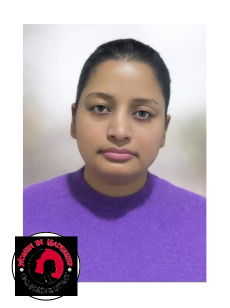 Read More about Anjali Kadka
Anjali Kadka
MASTER OF SCIENCE IN BUSINESS ANALYTICS
My project analyzes regional differences in unpaid caregiving time across U.S. metropolitan areas using 2020– 2024 American Time Use Survey (ATUS) data. We examine how caregiving varies by Census region and gender, and estimate its impact on employment outcomes using weighted descriptive statistics and regression analysis. The findings highlight significant regional and gender disparities in both caregiving time and associated labor market penalties, underscoring the economic value of unpaid care work and the need for region-specific policy responses.
Data Source
2020–2024 American Time Use Survey (ATUS)
Methods
Weighted descriptive statistics, Regression analysis, Regional and gender comparisons by Census region
Key Findings
Significant regional and gender disparities in both caregiving time and associated labor market penalties, underscoring the economic value of unpaid care work and the need for region- specific policy responses.
 Read More about Manish Parmar
Manish Parmar
MS IN STATISTICS (CONCENTRATION IN DATA SCIENCE)
My project studies households balancing both childcare and eldercare responsibilities to better understand the economic pressures faced by the "sandwich generation." Using nationally representative data, I analyze employment patterns, income, time allocation, and household composition to assess whether integrated caregiving models could improve efficiency and reduce costs. The findings aim to inform policies and startup models that respond to caregiver shortages in both childcare and eldercare sectors.
Employment Patterns
Analyzing how dual caregiving responsibilities affect workforce participation
Household Composition
Evaluating whether integrated caregiving models could improve efficiency and reduce costs
Income & Time Allocation
Assessing economic pressures and time demands on the "sandwich generation"
Policy & Innovation
Informing policies and startup models that respond to caregiver shortages in both childcare and eldercare sectors
 Read More about Drake Hashimoto
Drake Hashimoto
B.S. STATISTICS WITH DATA SCIENCE CONCENTRATION
This project examines how childcare costs in California compare to those in the lowest-cost childcare state in the United States, using county-level data from the National Database of Childcare Prices from 2008 to 2018. We first identify the benchmark state by calculating average childcare costs across states, then conduct descriptive comparisons using boxplots, histograms, and county-level analyses to highlight differences in cost distributions and within state variability.
Benchmark Identification
Calculate average childcare costs across states to identify the lowest cost state
Descriptive Comparisons
Boxplots, histograms, and county level analyses to highlight differences in cost distributions and within state variability
Affordability Assessment
Childcare cost burden measure: annual childcare cost divided by median household income
Hypothesis Testing
Two-sample t tests and Mann-Whitney U tests to formally assess cost differences
Linear Regression
Identify key factors: median household income, female labor force participation, service sector employment, and household structure
 Read More about Leila Elayed
Leila Elayed
Myproject is exploring elderly caregiving prevalence and its economic impact one mployment and earnings, and how it varies across U.S. geographical regions. Understanding elderly caregiving and its economic impact, this can inform public policy on support for elderly care and systems to put into place to create sustainable options for the elderly and their caregivers.
Research Focus
Elderly caregiving prevalence and its economic impact on employment and earnings
Geographic Scope
How caregiving impact varies across U.S. geographical regions
Policy Goa
Inform public policy on supports for elderly care and systems to create sustainable options for elderly and their caregivers
 Read More about Catherin Gonzalez
Catherin Gonzalez
MASTER IN STATISTICS
I am investigating how unpaid childcare responsibilities differ across race and income levels, and whether these burdens contribute to lower earnings for women of color. I want to understand how childcare inequities might be limiting financial independence and economic advancement for some families more than others, and I will be utilizing an IPUMS-ATUS (2014-2024) dataset for this analysis.
My goal is to reveal inequities in unpaid childcare across race and socioeconomic status, to help inform measures and policy to target these inequities, such as governmental support and benefit programs.
Investigate
How unpaid childcare responsibilities differ across race and income levels
Analyze
Whether these burdens contribute to lower earnings for women of color using IPUMS- ATUS (2014-2024)
Inform
Measures and policy to target inequities, such as governmental support and benefit programs